Trust Your Bots (Terms Apply)
AI providers ask us to trust agents with our accounts and real work, while their terms of service put every consequence on the user. Before I hand an agent the keys, one question needs an answer: who is responsible when something goes wrong?
xAI launched Grok Bot today: “AI teammates you can give real work to.” Each bot gets a computer of its own in the cloud, signs into the tools you already use, watches you do a job once, and runs it on its own from then on (Grok Bot launch post).
I really like the product. None of the ideas are new on their own: agents with their own computers, memory, learned routines, bots handing work to each other. They existed as fragments spread across different tools, and Grok Bot combines them into one coherent product.
For the last year the big thing was letting agents write code on our behalf. It was easy to imagine where a coding agent goes in the software development process: it writes code, I review it before releasing. It looks obvious now that the next big thing will be letting them use computers and browsers. This feels a lot like uncharted territory. I give it access to my accounts and it can do anything?
Trust your Bots
There is one part of the announcement, though, that I keep coming back to. Quoting the blog, I am being told I should “Trust your Bots with more over time”:
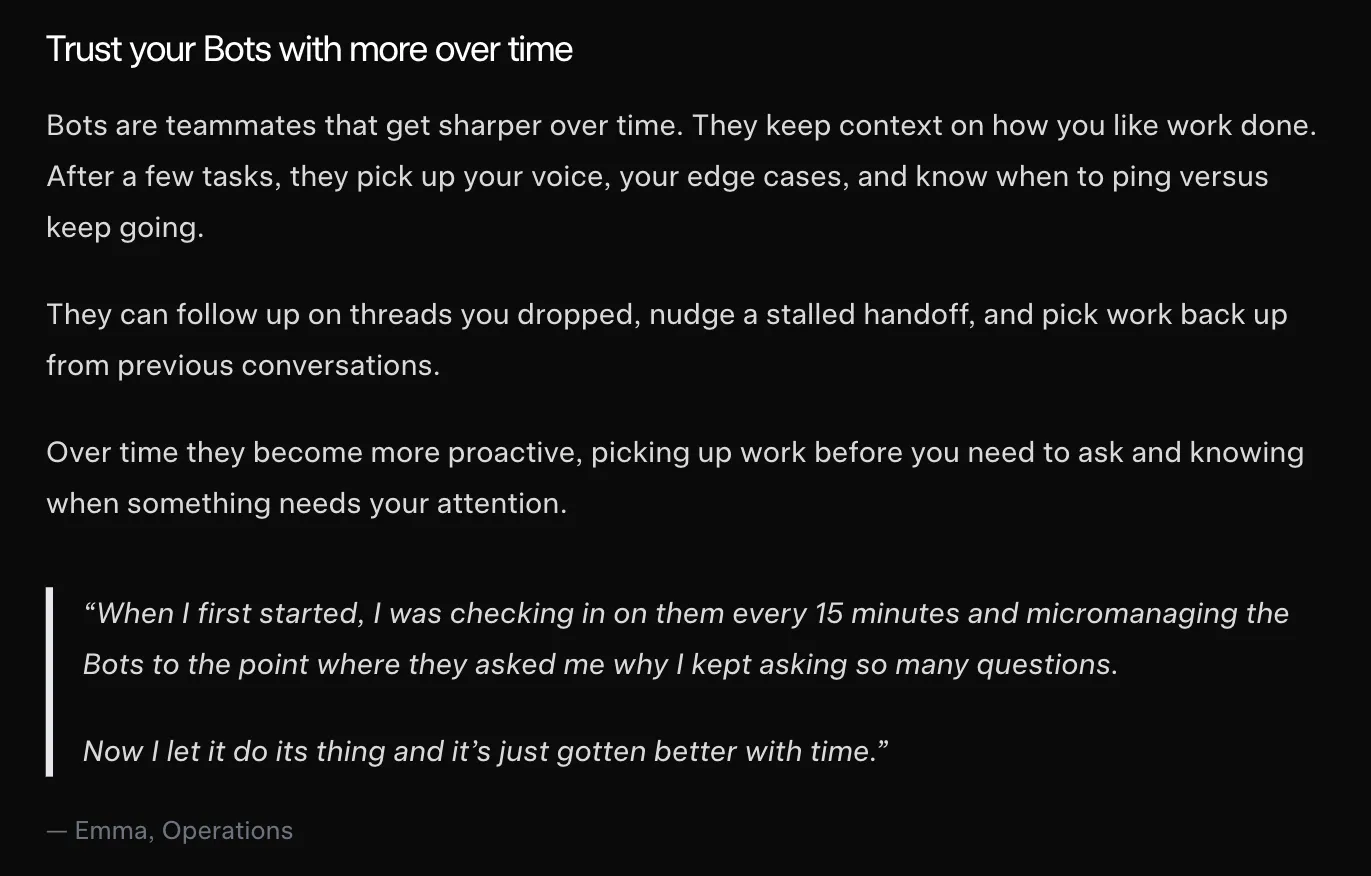
What I do not get is: what happens if something goes wrong? I can’t be responsible right? I just trusted the agent like I was asked to. Except it is me. Read the terms yourself:
Certain features of the Service may enable Grok to take autonomous actions on your behalf (“Agentic Actions”), including (…) interactions with third-party services, including financial institutions. We are not responsible for User Content or Agentic Actions. You are responsible for User Content and Agentic Actions, including (…) any consequences, costs, or liabilities arising therefrom.
(xAI Terms of Service, “User Content” section, effective June 26, 2026)
If that was a bit complicated, here is what I understand from it when I read it next to the announcement blog:
You will need to grant access to everything because if you do not grant access you will not be able to keep up with your peers and your competition. And if granting access results in something going terribly wrong, good luck with that!
If I am being asked to trust these tools, some confidence from the providers would be nice.
Not a new topic
Here is how an IBM training presentation settled it in one slide in 1979:
Nothing about the premise has changed since 1979. The computer still cannot be held accountable. The accountability has to go somewhere, and the terms tell you exactly where.